

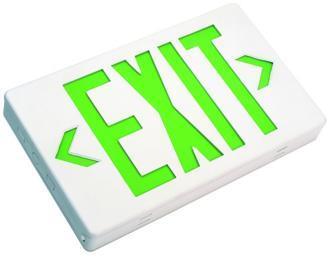
Illuminated Exit Signs
THE PRODUCT:
An illuminated exit sign is designed to be permanently fixed in place to identify an exit.
THE STANDARD:
Traditionally, exit signs used small incandescent bulbs. However, these signs operate all the time, making energy use high. For example, a 40 W exit sign will cost $35/year to operate at an electricity cost of 10 cents/kWh. To address this high energy use, manufacturers first developed compact fluorescent exit signs (typically using around 13 W) and then developed LED (light emitting diode) exit signs (typically using 3-4 W). The LED signs were promoted by the Energy Star program and many utility and state programs. California and other states then adopted standards requiring use of exit signs using no more than 5 W per face (e.g. 5 W for a one direction sign, 10 W for a sign that faces two different directions). Congress made this a national standard in 2005, with the standard taking effect in January 2006.
Illuminated Exit Sign documentation can be found in EPAct 2005.
Timeline
| Federal | Date | State |
|---|---|---|
| 2008 | AZ Standard Effective * | |
| 2007 | WA Standard Effective * | |
| 2007 | NJ Standard Effective * | |
| 2007 | RI Standard Effective * | |
| 2007 | OR Standard Effective * | |
| 2006 | CT Standard Effective * | |
| 1st Federal Standard Effective | 2006 | |
| 2005 | MD Standard Effective | |
| EPACT Initial Federal Legislation Enacted | 2005 | |
| 2005 | WA Standard Adopted | |
| 2005 | NJ Standard Adopted | |
| 2005 | AZ Standard Adopted | |
| 2005 | RI Standard Adopted | |
| 2005 | OR Standard Adopted | |
| 2005 | NY Standard Adopted | |
| 1st Federal Standard Adopted (Congress) | 2005 | |
| 2004 | CT Standard Adopted | |
| 2004 | MD Standard Adopted | |
| 2003 | CA Standard Effective | |
| 2002 | CA Standard Adopted |
* State standard never went into effect due to preemption by federal standard.
States not showing an effective date have an ongoing rulemaking process to determine standards.
Timeline reflects state standards from 2001 to present; federal standards from inception to present.


